
The Red Iron 2026: Projects, People and Progress Across Crossland
| 8 minute read
Every project has a story behind it.
There are the buildings and infrastructure people see. Then there are the teams, relationships, challenges, decisions, and thousands of hours of work that made them possible.
That’s what The Red Iron, Crossland’s annual magazine, is about.
The 2026 issue looks back at another year of growth across Crossland Companies, with stories spanning commercial construction, education, healthcare, parks and recreation, industrial facilities, water and wastewater infrastructure, workforce development, and the communities our teams call home.
And while the projects cover a lot of ground, one theme runs through the entire issue: growth means more when you grow the right way.
Growing Without Losing What Got Us Here
Crossland began in 1977 with a small construction company operating out of a garage. Nearly 50 years later, the company has grown to more than 2,000 employees and become one of the nation’s largest construction firms.
That growth continued in 2026.
Crossland moved to No. 47 on Engineering News-Record’s Top 400 Contractors list, following the company’s first appearance in the national Top 50 the previous year. The company also earned recognition from Associated Builders and Contractors as a Top Performer. Red Iron Newsletter 2026-digital
But numbers only tell part of the story.
As CEO Ivan Crossland Jr. shares in this year’s Red Iron Corner, the foundation remains much the same: work hard, keep your word, take care of people, and continue doing things the right way.
Building Places That Become Part of a Community
Some of the biggest stories in this year’s magazine aren’t simply about square footage or project values. They’re about what happens after construction ends.
One example is Crossland Stadium at Wichita State University. The redevelopment of the former Cessna Stadium is creating a modern venue for athletics, university events, community gatherings, and the Kansas State High School Activities Association Track and Field Championship. When complete, the stadium will accommodate more than 12,000 spectators.
The relationship behind the project matters just as much. Crossland’s work with Wichita State extends across the university and its Innovation Campus, making the stadium the latest chapter in a much larger partnership.
That connection between construction and community also drives this year’s cover story: Building Communities That Last.
Parks Built For More Than Play
Today’s parks do much more than fill open space. They can support recreation, public health, tourism, environmental restoration, economic development, and the everyday quality of life of a community.
That complexity requires much more than traditional vertical construction.
Crossland Construction, Crossland Heavy Contractors, and Crossland’s Civil Division bring together vertical construction, earthwork, utilities, stormwater management, bridges, roadways, trails, structures, and large-scale infrastructure to deliver these increasingly complex public spaces. Red Iron Newsletter 2026-digital
The issue looks back at Gathering Place in Tulsa, the 98-acre riverfront park that became a milestone in Crossland’s parks portfolio. The project includes six miles of paths, land bridges, timber bridges, destination playgrounds, park buildings, and gathering spaces. Red Iron Newsletter 2026-digital
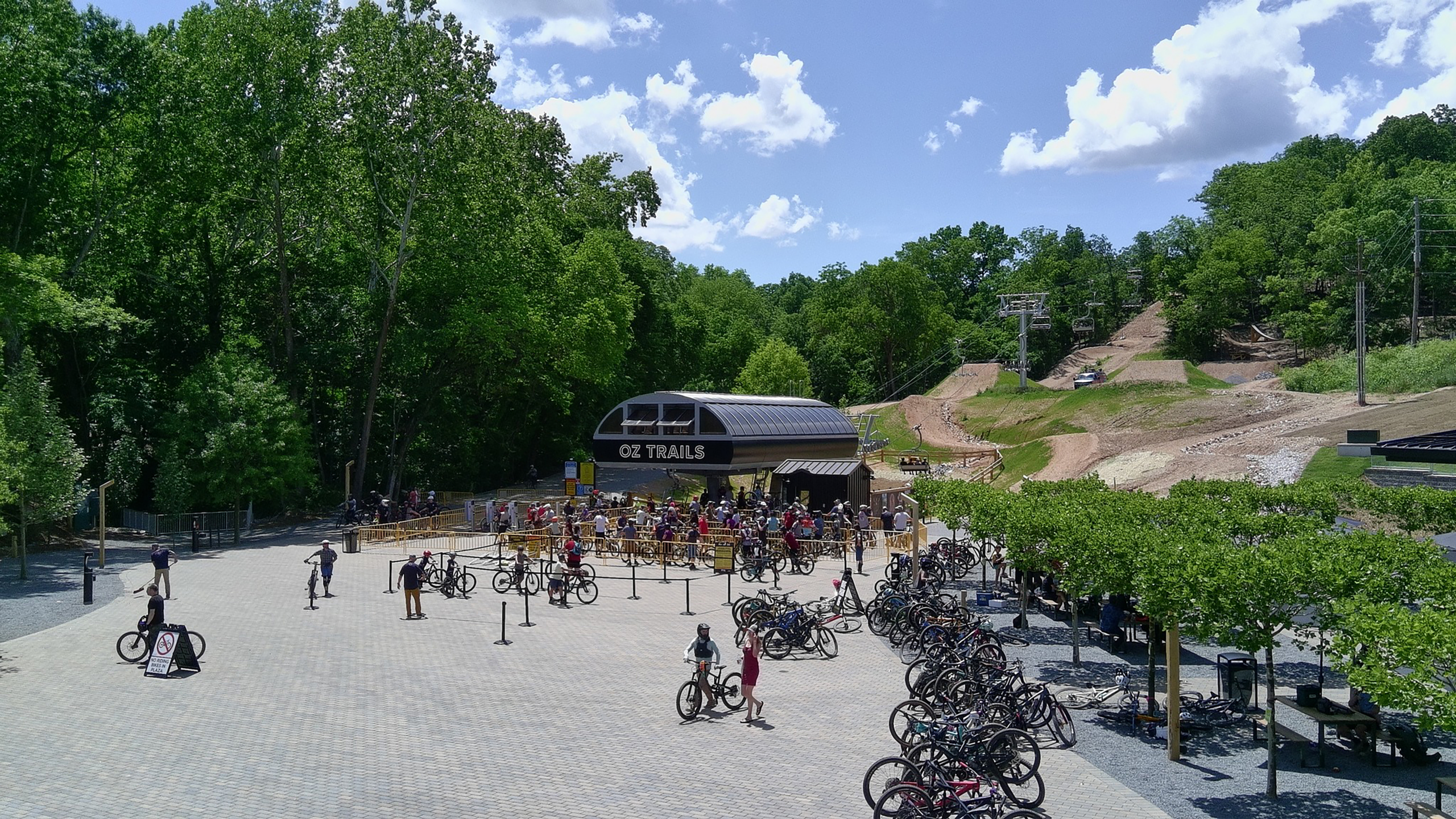
It also highlights work across projects including Coler Mountain Bike Preserve, Lake Atalanta, WOKA Whitewater Park, OZ Trails Bike Park, Grand Park, Harold Simmons Park, Berry Park, and other outdoor destinations.
They are different projects in different communities. But the objective is similar: build places people will actually use, experience, and remember.
30 Years of Building in Arkansas
This year’s Red Iron also marks an important milestone: 30 years of Crossland in Arkansas.
Crossland put down roots in Arkansas in 1996 with a small team and relatively little name recognition in the market. Over the next three decades, that team helped deliver projects across education, healthcare, office, entertainment, infrastructure, parks, and trails throughout Northwest Arkansas.
This issue revisits projects that helped shape that history, from Ferritor Hall at the University of Arkansas and Pinnacle Hills Promenade to Naturals Stadium, Walmart AMP, Hunt Tower, Northwest Arkansas’ growing network of quality-of-life projects, and the Alice L. Walton School of Medicine.
But the 30-year story isn’t really about a project list.
It’s about the employees who built careers here, the clients who trusted Crossland, and the relationships developed one project at a time. As the magazine puts it, Arkansas isn’t simply somewhere Crossland works anymore. It’s home.
Taking On More Complex Construction
The 2026 Red Iron also showcases the increasingly complex work Crossland teams are taking on across the country.
In Tulsa, the nearly 319,000-square-foot Veterans Hospital is transforming a more than 50-year-old government building into a 98-bed healthcare facility. The adaptive reuse project combines structural rehabilitation, federal security requirements, advanced medical infrastructure, and major self-perform scopes. Close collaboration during curtain wall planning helped generate approximately $7 million in project savings. R
Other featured projects demonstrate the range of work happening across Crossland:
- Roy Blunt Health Science Innovation Center at Missouri Southern State University brings real-world medical environments into a hands-on teaching facility, including a fully functional mock hospital.
- Fletcher Miller School in Lakewood, Colorado, was designed around accessibility, therapy, medical support, and greater independence for students with severe physical and developmental disabilities. Red Iron Newsletter 2026-digital
- Pipkin Middle School in Springfield, Missouri, was delivered in just 12 months and received its Certificate of Occupancy more than two months ahead of its contractual completion date. Red Iron Newsletter 2026-digital
- Sunbelt Rentals’ Grapevine campus combines a three-story headquarters with four specialized warehouse buildings across a 17-acre, LEED Gold-certified development. Red Iron Newsletter 2026-digital
- Rollertown Brewery in Frisco transformed an empty site into a brewery, taproom, beer garden, event venue, and community gathering place in the city’s Rail District. Red Iron Newsletter 2026-digital
Different markets. Different challenges. The same expectation to solve problems and get the work done.
Infrastructure You May Never See, But Depend On Every Day
Some of the largest work featured in The Red Iron happens mostly out of sight.
Crossland Heavy Contractors continues to deliver critical water, wastewater, roadway, bridge, and infrastructure projects across the region. Red Iron Newsletter 2026-digital
In Okemah, Oklahoma, CHC replaced an aging water treatment facility while keeping the existing plant operational, increasing capacity from 1 million gallons per day to 5 million gallons per day.
Near Lincoln, Nebraska, the team completed a 2,080-linear-foot horizontal directional drill of 54-inch steel pipe beneath the Platte River—a record pull for design partner Black & Veatch and believed to be the largest HDD of its type completed anywhere in the world.
In Northwest Arkansas, work is underway on Beaver Water District’s new 80-million-gallon-per-day Starr Water Treatment Facility, while the Kill Creek Water Resource Recovery Facility in Gardner, Kansas, is adding another 2.5 MGD of treatment capacity.
These aren’t always the projects people notice.
They are the projects communities depend on.
Building The Next Generation Of Builders
The Red Iron isn’t only a construction magazine. It’s also about the people behind the construction.
Crossland welcomed a company-record 326 interns in 2026, including 218 college interns and 108 Kickstart high school interns. The internship program was also recognized as one of Yello and WayUp’s Top 100 Internship Programs of 2026.
Another 86 employees joined Crossland’s Emerging Leaders program, bringing together field and office employees to strengthen leadership skills and learn more about operations across the company.
And 50 Crossland apprentices earned NCCER certification through Crossland Academy, developing craft skills through classroom learning, hands-on field experience, and mentorship.
Crossland also expanded its Columbus, Kansas, campus with a new Crossland Heavy Contractors headquarters, an office addition for the Midwest and National Accounts teams, and a new training facility designed to support collaboration and hands-on learning.
Because building the future of construction requires more than finding people.
It requires developing them.
Building Beyond The Jobsite
Our responsibility to the communities we serve doesn’t end when a project is complete.
Through Crossland Cares, employees continue to volunteer, give, and support organizations across the communities where they live and work.
This year included employees packing 2,420 pounds of food for the Food Bank of Eastern Oklahoma, teacher appreciation efforts, Salvation Army Angel Tree support, student service projects, and continued support for first responders.
The inaugural Crossland Country Limits benefit concert in Texas also raised more than $75,000 for 3FTL, a nonprofit providing mental health and crisis support for first responders.
Those efforts may look very different from construction.
But they’re part of the same idea.
Build stronger communities. Take care of people. Leave something better behind.
Read The 2026 Red Iron
There’s a lot that happens across Crossland in a year, and The Red Iron gives us a chance to stop and look back at some of it.
The projects. The people behind them. The challenges our teams worked through. The communities we’re proud to be part of. And the relationships that continue to move us forward.
Nearly 50 years after Ivan Crossland Sr. started the company out of a garage in Columbus, Kansas, a lot has changed. We’ve grown. Our capabilities have grown. And the work has taken us farther than he probably could have imagined.
But the things that matter most haven’t changed.
Work hard. Do what you say you’ll do. Take care of people and relationships. And take pride in what you build.
Read the full 2026 edition of The Red Iron
Latest News
